

The Role of Oxygen in Healing and Wellness
The Role of Oxygen in Healing and Wellness
Science-Backed Guidance for Birmingham | Active Clinics
We breathe roughly 20,000 times a day without thinking about it. Yet oxygen is far more than the gas that keeps us alive. It is the single most important driver of healing, cellular repair, energy production, immune function, and skin health in the human body.
When oxygen reaches your tissues in adequate amounts, your body heals efficiently, ages more slowly, and performs at its best. When it does not, every system suffers. Here is what the science actually says, and how the treatments at Active Clinics Birmingham are designed to support your body's oxygen biology.
Oxygen and Cellular Energy: The Foundation of Everything
Every cell in your body uses oxygen to produce ATP, the energy that powers all biological processes, through a process called oxidative phosphorylation in the mitochondria. Without adequate oxygen, cells fall back on a far less efficient energy pathway, producing lactic acid and leaving tissues starved of the energy needed to repair and function properly.
- Mitochondria convert oxygen and glucose into usable cellular energy
- Even mild tissue hypoxia measurably impairs cellular function and repair
- The brain, heart, and muscles are among the most oxygen-sensitive tissues
Research: Semba et al. (2019), Physiological Reviews, confirmed that mitochondrial dysfunction driven by reduced cellular oxygenation is a central mechanism in biological ageing and a major contributor to reduced healthspan.
Oxygen and Wound Healing: What the Research Confirms
Tissue repair depends on oxygen at every stage. Immune cells need it to destroy bacteria. Fibroblasts need it to synthesise collagen and close wounds. Without adequate local oxygen, healing slows significantly and infection risk rises. Research consistently places tissue oxygen tension at the top of the list of factors governing healing outcomes.
- Immune cells use oxygen-dependent reactions to kill pathogens at wound sites
- Collagen synthesis requires molecular oxygen as a direct enzymatic cofactor
- Hypoxic wound environments heal more slowly and with higher complication rates
Research: Rodriguez et al. (2018), Advances in Wound Care, concluded that tissue oxygen tension is the single most important environmental factor governing wound healing, with adequate oxygenation reducing chronic wound complications by up to 60% across reviewed clinical trials.
Hyperbaric Oxygen Therapy : Delivering Oxygen Deeper
Standard breathing delivers oxygen through haemoglobin in red blood cells. This works well for healthy tissue but fails in damaged, inflamed, or poorly vascularised areas. Hyperbaric Oxygen Therapy solves this by using a pressurised chamber where you breathe Almost 100% pure oxygen at 2 times normal atmospheric pressure. Oxygen dissolves directly into blood plasma, lymph, and tissue fluid, reaching cells that normal circulation cannot adequately supply.
- HBOT increases dissolved plasma oxygen by up to 2,000% compared to normal breathing
- Oxygen reaches ischaemic tissue through diffusion, independent of red blood cells
- Stimulates new blood vessel growth, stem cell mobilisation, and collagen production
- Sessions at Active Clinics Birmingham last 60 to 90 minutes and are non-invasive
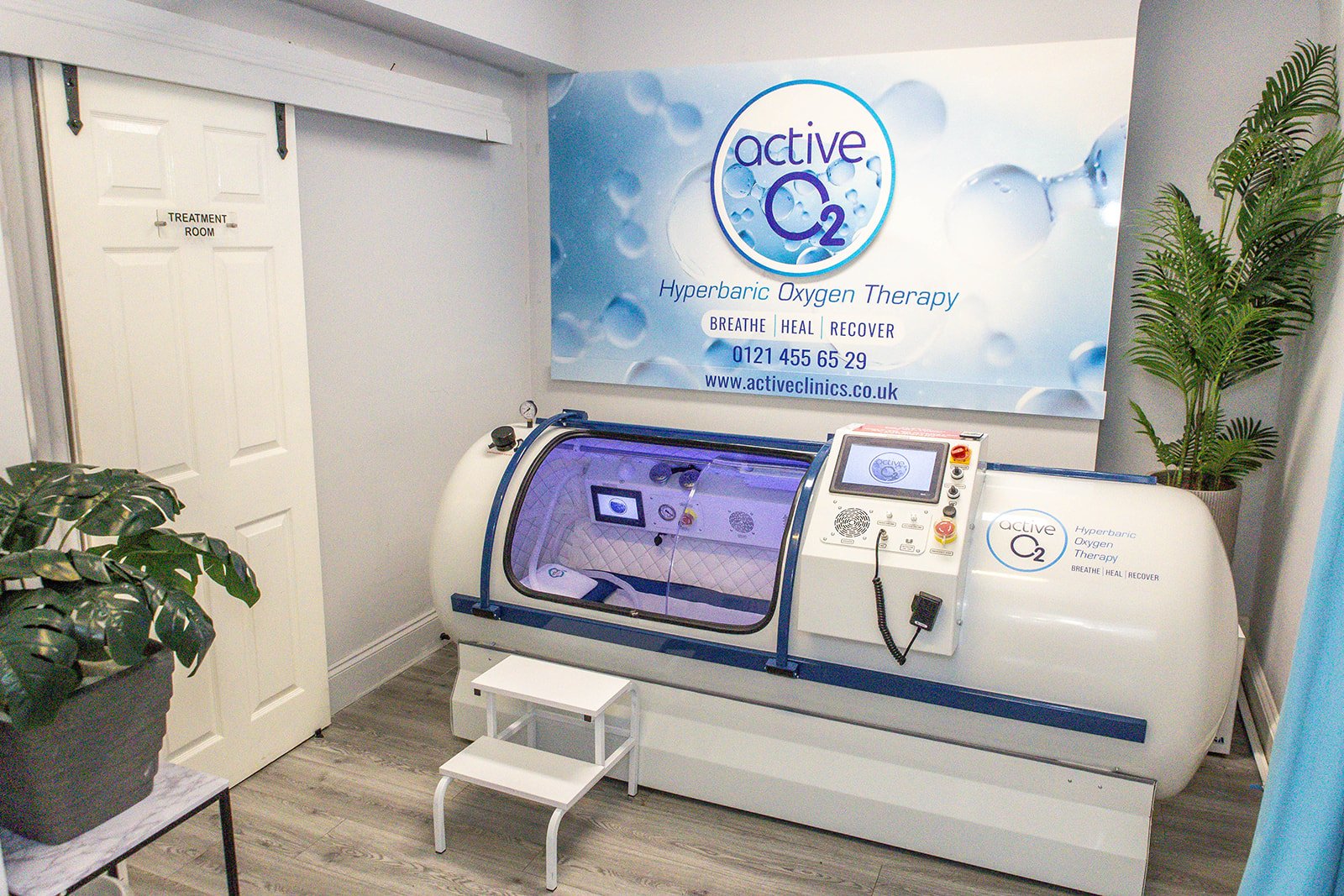
Research: Bennett et al. (2016), Cochrane Database of Systematic Reviews, analysed 12 randomised controlled trials and found that HBOT significantly improved healing outcomes and reduced major amputation rates in diabetic foot ulcer patients compared to standard care alone.
Active Clinics Insight: Beyond medical applications, Hyperbaric Oxygen Therapy Birmingham is used by wellness clients across Birmingham for recovery, anti-ageing, fatigue support, and cognitive performance, all grounded in the same oxygen science.
Oxygen, Collagen, and Skin Health
Collagen synthesis is entirely oxygen-dependent. The enzyme that stabilises the collagen structure requires molecular oxygen to function. As skin ages and microvascular density declines, skin tissue becomes progressively less well-oxygenated. This is one of the primary biological drivers of the fine lines, dullness, and loss of firmness that come with age.
- Collagen-stabilising enzymes require oxygen as a direct cofactor
- Skin oxygen tension declines measurably with age and cumulative sun damage
- Improving skin oxygenation supports collagen production and a more vital complexion
Research: Tandara and Mustoe (2004), Journal of Investigative Dermatology, found that fibroblasts in well-oxygenated environments produced significantly more collagen and demonstrated superior wound-closing capacity compared to those in hypoxic conditions.
At Active Clinics, several treatments leverage this oxygen-collagen relationship. HIFU Treatment Birmingham delivers focused ultrasound energy to deep skin layers, triggering the same oxygen-dependent collagen repair response as wound healing without any surface disruption.
Oxygen and the Brain: Clarity, Focus, and Cognitive Health
The brain consumes 20% of the body's oxygen supply while accounting for only 2% of its mass. Even mild reductions in cerebral oxygenation produce immediate effects on concentration, memory, and mood. Chronic mild cerebral hypoxia is increasingly linked to accelerated cognitive decline with age.
- The brain requires continuous high-volume oxygen delivery to maintain function
- Reduced cerebral blood flow is measurable in individuals with cognitive impairment
- HBOT dissolves oxygen into plasma, reaching brain tissue more efficiently
Research: Harpaz et al. (2020), Aging, found that a 60-session HBOT protocol in healthy ageing adults produced significant improvements in memory, attention, and processing speed alongside measurable increases in cerebral blood flow and telomere lengthening, a biological marker of cellular rejuvenation.
Supporting Oxygen Biology from the Inside Out
Oxygen-dependent processes in the body require specific nutrients to function. Without the right nutritional cofactors, even excellent oxygenation cannot produce optimal results. This is why nutritional therapies complement oxygen-focused treatments so effectively.
IV Drip Therapy Birmingham delivers Vitamin C, B vitamins, magnesium, and glutathione directly into the bloodstream at concentrations oral supplements cannot achieve. Vitamin C is a direct cofactor in oxygen-dependent collagen synthesis. B vitamins support mitochondrial energy production. Glutathione protects cells from oxidative stress generated during healing. Vitamin B12 Injections Birmingham are equally important, since B12 deficiency directly impairs red blood cell production, reducing the blood's oxygen-carrying capacity and leaving tissues oxygen-starved regardless of how much oxygen is available.
Research: Carr and Maggini (2017), Nutrients, confirmed that intravenous Vitamin C achieves plasma concentrations up to 70 times higher than oral supplementation, making IV delivery the most clinically effective route for therapeutic nutritional support of oxygen-dependent healing processes.
Recovery, Cold Therapy, and the Oxygen Connection
Physical stress and exercise produce inflammatory byproducts that must be cleared for recovery to occur. Cryotherapy Chamber sessions trigger powerful vasodilation as the body rewarms after cold exposure, producing a surge of oxygenated blood to muscles and joints. This complements HBOT's direct tissue oxygenation and creates one of the most effective dual recovery protocols available at Active Clinics Birmingham.
- Cold-induced vasodilation delivers a surge of oxygen-rich blood to recovering tissue
- Cryotherapy reduces inflammation, creating a better environment for oxygen-dependent repair
- Combining HBOT and cryotherapy addresses recovery from two complementary directions
Research: Bleakley et al. (2012), PLOS ONE, found that whole-body cryotherapy significantly reduced markers of muscle damage and systemic inflammation post-exercise, with vasodilation rebound identified as a key mechanism enhancing peripheral oxygen delivery.
Frequently Asked Questions
How does HBOT differ from simply breathing deeply?
Deep breathing cannot significantly increase oxygen dissolved in blood plasma under normal atmospheric pressure. HBOT uses pressure to force oxygen directly into plasma and tissue fluid, achieving concentrations that are simply not possible through breathing alone.
Which treatment is right for me?
It depends on your goals. A consultation at Active Clinics Birmingham will identify whether Hyperbaric Oxygen Therapy Birmingham, IV Drip Therapy Birmingham, Cryotherapy Chamber Birmingham, or a combination is most appropriate.
Final Thought
Oxygen is the thread connecting every healing process in the body. At Active Clinics Birmingham, every treatment we offer is grounded in supporting that biology, from Hyperbaric Oxygen Therapy Birmingham and IV Drip Therapy to Cryotherapy.
Give your body the oxygen and nutritional support it needs, and it will do the rest. Visit activeclinics.co.uk to book your consultation today.
Our Team
We are a dedicated team of qualified skin specialists, health and wellness experts, and professional sports therapists, committed to helping you look, feel, and perform your best
Learn More